
We hand undergraduates real spacecraft hardware, and the responsibility that comes with it, early enough that they graduate having built something that actually flew.
Who are we?
We're 80 students across mechanical, electrical, software, systems, and physics, and SCALAR, our first satellite, is working through the last of its launch requirements.
Along the way we flew a payload on a balloon over Tisch Park, designed an optical telescope headed for a NASA flight over Antarctica, and built the ground station we'll use to talk to our own spacecraft. Students designed, machined, soldered, and coded all of it.
Almost nobody arrives knowing how to do any of this. You learn it here, next to people working out the same problems, and you graduate having built things most engineers don't touch until years into a career. We have a good time doing it, and we're always looking for people who want in.
Meet the team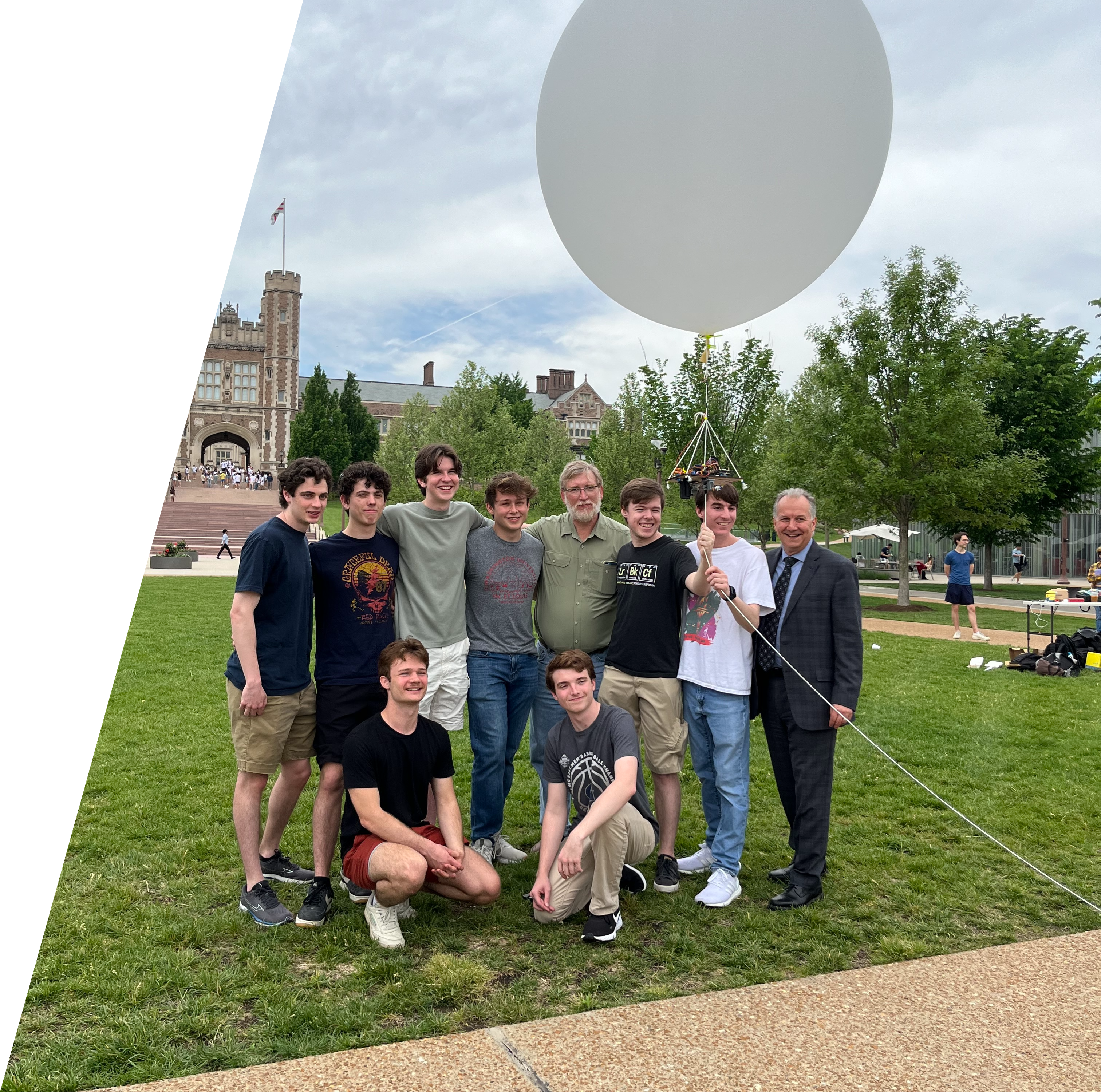
SP24 Team Photo
Next Launches01
AIRIS
Antarctic balloon flight (target date pending NASA decision)
Target: Dec 1, 2026
1791311424889SCALAR
1U CubeSat — launching 2027
Date under NDA
1791311424890Timeline02
← Past
Future →
Jan 2024
Done
Club founded
WashU Satellite founded with 11 initial members.
Apr 2024
Done
SB-1 launch
First mission: small balloon launched from Tisch Park.
Aug 2024
Done
Team procedures formalized
Engineering reviews, budgets, and responsible-engineering standards adopted.
Oct 2024
Done
GS-1 PDRs
Preliminary design reviews for the first ground station passed.
Late 2025
Done
GS-1 closed, GS-2 begins
The team closed out GS-1 and restarted as GS-2 with a written requirements sheet, carrying forward its hardware, software, and lessons learned.
Apr 2026
Done
SCALAR passes program entry review
Initial design package accepted, moving SCALAR from concept into flight development.
2026
In progress
AIRIS in development
A fast-slewing optical telescope flying on ADAPT, a NASA near-space balloon over Antarctica, imaging gamma-ray burst afterglows for the multi-messenger collaboration.
Jun 2026
Done
SCALAR range safety review passed
Range safety requirements accepted, with ground operations and transport planning complete.
2026
In progress
GS-2 in assembly
Antenna simulation, structures, and control software in progress across seven modules, aimed at rapid data downlink. Rooftop site selected.
Aug 2026
In progress
SCALAR engineering model build
The integrated 3D prototype is done and the full engineering model enters machining and assembly, with mass properties and the test plan settled.
Fall 2026
Planned
VECTOR concept work begins
Project kickoff, systems engineering and integration leads named, sensor and lens trade study opens.
Late 2026
Planned
SCALAR protoflight testing
Vibration and thermal testing to qualify the flight unit for launch.
Feb 2027
Planned
GS-2 operational
Second ground station assembled, tested, and ready to command SCALAR from the Crow Hall rooftop.
Early 2027
Planned
SCALAR launch
Our first satellite reaches orbit: a 1U CubeSat demonstrating attitude control with magnetic torque rods, bus endurance, and ground-side mission operations.
Feb 2027
Planned
VECTOR proposal complete
University Nanosatellite Program proposal draft finished, closing out the VECTOR concept phase.
2027+
Planned
VECTOR development begins
Versatile Educational Controls Testbed for Optical Response — the next step after SCALAR, carrying configurable algorithms for transient observation.